Connection Fiber • Mesa, AZ • 2,055 Homes
Access code is a formality. Shared only with selected recipients.
This portal lays out the full five-community footprint, build status, proof of architecture, transport/backhaul strategy, and a per-property financial engine so an operator or strategic partner can evaluate each asset independently or as a unified portfolio.
Exclusive community access + repeatable OSP + transport control drives superior margins. Where others pay permanent upstream, we can build a backhaul moat (CLAC concept) that reduces Connection Fiber’s costs while capturing margin inside the operating structure.
Click any card to open that property’s dedicated page with its own sliders, EBITDA output, and asset gallery.
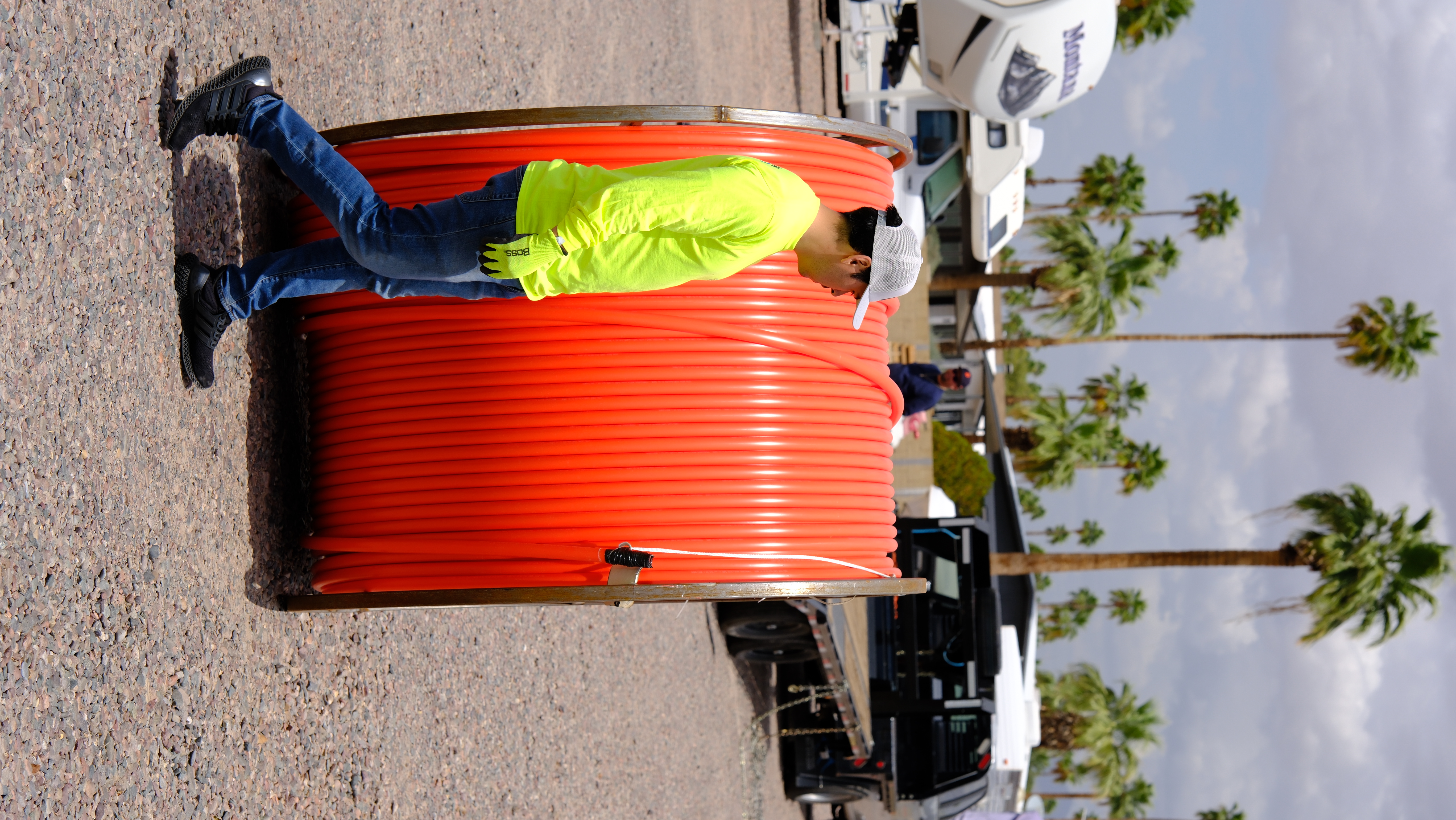
35% overall conduit complete
Headend staged; path to first-light upon transport tie-in.
Open Saguaro Page10% conduit & vaults installed
Rapid route to first-light once transport is finalized.
Open Mesa PageEngineering complete • Ready to deploy
Largest single-asset upside in Mesa portfolio.
Open Citrus PageMeet-me point inside clubhouse
Ready for headend install + transport tie-in.
Open Aspen PageFast check before drilling into each property page.
Track homes passed, homes activated, and hard cost per home across all five communities. Adjust each community independently or view the portfolio-wide average. Drill into any community to understand cost drivers and identify the lowest cost-per-home-connected for replication.
The cyan slider sets total homes passed. The green slider (capped at homes passed) sets homes activated/connected.
Save the current setpoints so all visitors see the same up-to-date figures across the site.
Lowest cost/home connected ranks first. Use this to identify which community build to replicate.
All current photos & plans provided are surfaced here for this property.
Adjust assumptions and see subs, MRR, and EBITDA. Includes optional upstream/backhaul cost.
Dorado is the proof base: distribution layout, vault strategy, splitter logic, install workflow, and the repeatable field playbook. The purpose of this section is to make an operator confident that the rest of Mesa is a replication problem—not a science project.
Investors and operators win when uncertainty collapses. Dorado collapses uncertainty by proving the build, proving the install flow, and proving the repeatability. Everything else is scaling discipline.
Standardized materials, vault kits, drop kits, and clear QA checkpoints reduce rework and customer dissatisfaction.
The fastest path is transport first, then staged OSP replication. The portal’s timeline page breaks that sequence into weeks.
Legal + operational discipline prevents “deal drift” across communities. Leadership section documents roles and enforcement.
These models are designed to support quick operator decision-making: penetration + ARPU + margin + upstream assumptions, then EBITDA and valuation scenarios. You can model each property or the entire 5-pack.
2,055 homes. Includes optional upstream/backhaul as a fixed monthly expense.
20,550 homes. Exit multiple applied to annual EBITDA.
If Connection Fiber pays upstream DIA for each property, margin is permanently capped. A CLAC-style entity that can deploy conduit in ROW and provide transport/backhaul between headends can convert that permanent expense into internal revenue while still offering a better rate to Connection Fiber.
Compare “pay upstream forever” vs “build transport once” and capture the margin internally.
If James + Morgan are the forward operators, a CLAC-style transport entity can be the “utility backbone” that CF buys from. That keeps CF’s customer experience and billing intact, while moving transport margin into the JV’s operator economics.
Permit & design. Finalize conduit path from Dorado headend tie-in to next community. Lock meet-me points. Confirm handholes and splice plan (if any).
Build backbone + drops-ready nodes. Establish transport to at least 2 additional communities to start replacing vendor DIA immediately.
Expand backbone to remaining Mesa footprint. Convert additional properties off vendor DIA where economically superior.
This is the “how it actually happens” plan: sequencing, capital press points, and decision gates. It’s designed for operator clarity and for a capital partner to see exactly where dollars go and why the engine turns.
Finalize transport path, lock procurement, schedule crews. Prioritize the fastest first-light property (Saguaro / Mesa Shadows segments already started).
Headend installs + feeder pulls. Start rolling activations as soon as the first segments are live — revenue begins before the full build is done.
Activation sprint + in-community enrollment conversion. Push to reach MRR that covers core OPEX and stabilizes build funding.
This model is intentionally simple: CAPEX is mostly OSP + labor. Speed is the moat. Use the sliders to estimate all-in remaining CAPEX and compare it to modeled Net EBITDA to estimate payback.
OSP completion + drops + CPE + labor average. Adjust based on trench vs pull vs aerial constraints.
Core electronics, racks, power, meet‑me work, transport build-out (or CLAC interconnect prep).
After upstream. Use Financial Engine page to compute this precisely; this is for quick timing math.
Payback is a blunt tool, but it’s useful: it shows the urgency of getting activations live quickly (build speed drives IRR).
| Property | Status now | First-light focus | Press point |
|---|---|---|---|
| Dorado Canyon | Live / proof base | Use as headend & operations template | Transport interconnect to rest of Mesa |
| Saguaro Sun | ~35% conduit | Finish feeder paths + first cluster | Headend transport + labor sprint |
| Mesa Shadows | ~10% conduit/vaults | Activate “ready” segments first | Drop cadence + CPE inventory |
| Citrus Gardens | Engineering complete | Start trench/pull once transport locked | OSP scale crews + permitting rhythm |
| Aspenwood | Engineering + meet‑me point | Headend install + backbone path | Upstream or CLAC handoff readiness |
Connection Fiber is built to be operated like an infrastructure business — fast decisions, clean accountability, and field-level execution that avoids complaints. These bios are written for partners who want to know “who is actually driving the machine.”
Morgan is a telecom operator with 15+ years of real-world, door-to-door and in-home service execution experience — sales, install logistics, field QA, and the day-to-day discipline it takes to scale without chaos. Early in his career, he became the #1 seller in the country for Dish Network direct-to-home within his first four months in the industry, setting rookie-year performance marks that still stand.
He later built and led high-output sales and operations teams across multiple states, then translated that execution model into infrastructure: designing a deployable fiber blueprint optimized for speed, cost control, and high take-rate in manufactured housing. Morgan also scaled a top-performing Arizona solar sales organization in 2021–2023 by building repeatable systems, recruiting and training teams, and managing high-volume customer pipelines.
David is a seasoned business and real estate attorney (Johnson Law) who operates as the firm’s legal backbone for infrastructure agreements — access, easements, vendor contracts, revenue share terms, and liability reduction. His role is to ensure the company stays protected as it scales into larger REIT environments and more complex partnership structures.
David also provides financial oversight discipline: contract compliance, risk flags, approval workflows, and clean documentation that makes diligence easier for future capital partners or buyers.
Field Lead: supervises trench/pull crews and punch lists.
Activation Crew: installs ONUs/routers and closes same-day.
Resident Success: handles simple support and churn prevention.
NetView is the resident-facing software layer being deployed into these communities as an upgrade/replacement to “MyCommunity.” It increases engagement, reduces friction for payments and service requests, and creates additional monetization channels that reinforce the fiber business.
Connection Fiber is positioned as the default internet option in the resident portal — enrollment, support, and announcements.
Residents use one app for community info, payments, and services — this increases retention and reduces marketing cost.
Vendors are presented as the “preferred” providers residents actually use. The platform can support: HVAC, plumbing, handyman, cleaning, wellness/yoga, mobility services, insurance, and local business discounts — while keeping Connection Fiber as the utility backbone.
This is not “ads for ads sake.” It creates a resident habit loop and a sticky relationship with community management — which makes fiber renewals, expansion, and future deployments easier.
This section surfaces all major plan assets and key photos currently referenced in the portal. If you provide more photo links, they can be added to this vault without changing the structure.
If you have additional “actual photos” that must be placed in specific locations, paste the Dropbox raw links (or upload them), and this portal will automatically present them in the correct property galleries.
Back to 5-PackA month-by-month deployment plan with exact costs, revenue collections, and running cash position. Click any number to edit it directly — all totals recalculate automatically. Use this to model different scenarios by adjusting costs, dates, and take-rate assumptions.
| Category | Description | Community | Amount | Target Date | Status | |
|---|---|---|---|---|---|---|
| TOTAL CAPEX | $0 | |||||
| Expense | Description | Monthly Cost | Start Month | End Month | Status | |
|---|---|---|---|---|---|---|
| TOTAL MONTHLY OPEX | $0 | |||||
Projected customer activations and recurring revenue. Click any subscriber count to adjust.
| Month | New Subs | Total Subs | Monthly Revenue | EBITDA | Net EBITDA | Cumulative Revenue |
|---|
Shows cumulative capital deployed versus cumulative net income, and the running cash position.
| Month | CAPEX Out | OPEX Out | Revenue In | Net Cash Flow | Cumulative Position |
|---|
Save all CAPEX, OPEX, revenue assumptions, and subscriber forecasts. All visitors will see the latest saved model.